 English
 Deutsch
 Español
 عربي
عربي
 français
 Włoski










HS-BG5000W-A5
View more
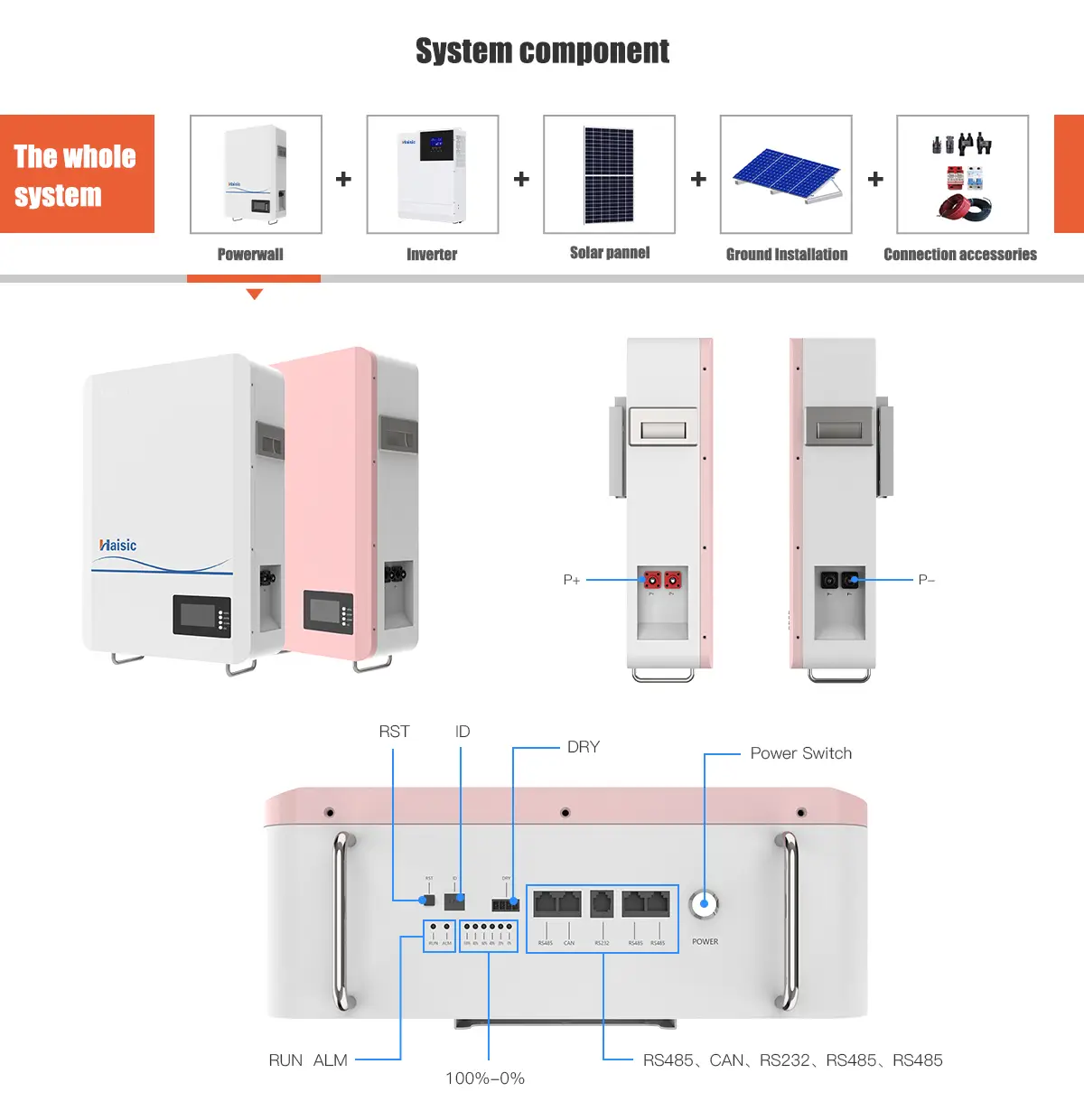
Powerwall is an integrated battery system that stores your solar energy for backup protection, ensuring that your power remains on even if the grid goes down. Your system detects power outages and automatically recharges with sunlight, allowing your appliances to run for several days.
What is a Powerwall?
Powerwall is an integrated battery system that stores your solar energy for backup protection, so when the grid goes down your power stays on. Your system detects outages and automatically recharges with sunlight to keep your appliances running for days.
Every solar purchase includes Powerwall, a compact home battery that reduces your reliance on the grid by storing your solar energy for use when the sun isn’t shining.
With easy installation and a minimalist design, Powerwall complements a variety of home styles and solar systems. The compact, all-in-one construction features versatile mounting options for indoor or outdoor spaces.

Rated Energy | 3584Wh |
Rated Capacity | 70Ah |
Rated Voltage | 51.2V |
Voltage Range | 44.8-56V |
Charge Voltage Range | 55.2-56V |
Cut-off Voltage | 44.8V |
Recommend Charge Current | 30A |
Max Charge Current | 60A |
Max Discharge Current | 60A |
Dimension | 374*138*530mm |
Communication Port | RS485,CAN |
Charge Temperature Range | 0-45℃ |
Discharge Temperature Range | -20-60℃ |
Storage Temperature Range | -20-45℃ |
Why do we need an energy storage system?
Energy storage is one of the best solutions to reduce utility costs without high infrastructure expenses. It transforms the way that homeowners, businesses, and utilities use power.
We are confident that an energy storage system is also an astute investment that can effectively reduce the electricity cost, especially when you are facing financial pressure caused by contingency or force majeure like a pandemic or bushfire.
Get access to energy independence and ensure the electricity supply even when the grid fails due to accidents.
- Decreasing ecological footprint by storing renewable energy such as solar power.
- Live a green life safe and sound by using a LiFePO4 battery and totally cobalt free.
- By storing the surplus PV generation in a battery storage unit, you can maximize self-consumption and reduce your electricity bill.
- Reduce your electricity bill by storing electricity during the off-peak time and shifting energy to be used at peak time.
- Selling excess renewable energy to the grid or directly to other users in the microgrid.



What to Look for in Home Battery Storage Systems?
Stackability
A single battery may not be able to power your whole home, so you’ll need to prioritize what’s essential, such as lights, outlets, air conditioning, the sump pump, and so on. But if you want to run everything in your house, some systems allow you to stack or piggyback more than one unit to achieve the level of backup you need.
AC vs. DC Coupled Systems
Batteries and solar panels store energy as direct current or DC. Connecting DC-coupled systems to solar results in less power loss. The grid and your home run on alternating current, or AC power. AC systems are slightly less efficient but more flexible and easier to install, especially if you already have solar.
Load Start Capability
Some appliances, such as central air conditioning or sump pumps, require more power to start up than once they are running. Make sure the system can accommodate your home’s specific appliance needs.



 Copy product links
 Long by picture save/share

Related Products
Contact Us

+86 13430797121

sales@haisicbattery.com
PRODUCTS
CONTACT US

Shenzhen Haishi Technology Co., Ltd.

深圳市海斯科技有限公司

Block C, No. 8, Second Industrial Zone, Tuyang Community, Kuiyong Street, Shenzhen, Guangdong, China
Room 903, Building 1, Hengda Metropolis Plaza, Bantian Street, Longgang District, Shenzhen, Guangdong Province, China
UNIT 135 1/F143 WAI YIP STREET KWUN TONG KL
+86 13430797121
sales@haisicbattery.com

Copyright © Shenzhen Haisic Technology Co., Ltd. All Rights Reserved.
Copyright © Shenzhen Haisic Technology Co., Ltd. All Rights Reserved.
 Sales
Sales